
Problematic Opioid Use in Ireland: Current Trends and Public Health Implications
Ireland continues to grapple with significant challenges related to problematic opioid use, though recent research reveals both concerning patterns and some encouraging developments. This analysis draws from the latest Health Research Board data and national surveillance systems to provide a comprehensive overview of the current situation and its implications for public health policy and practice.
Published on 5th August 2025. Generated by Perplexity.ai
Current Prevalence and Demographics
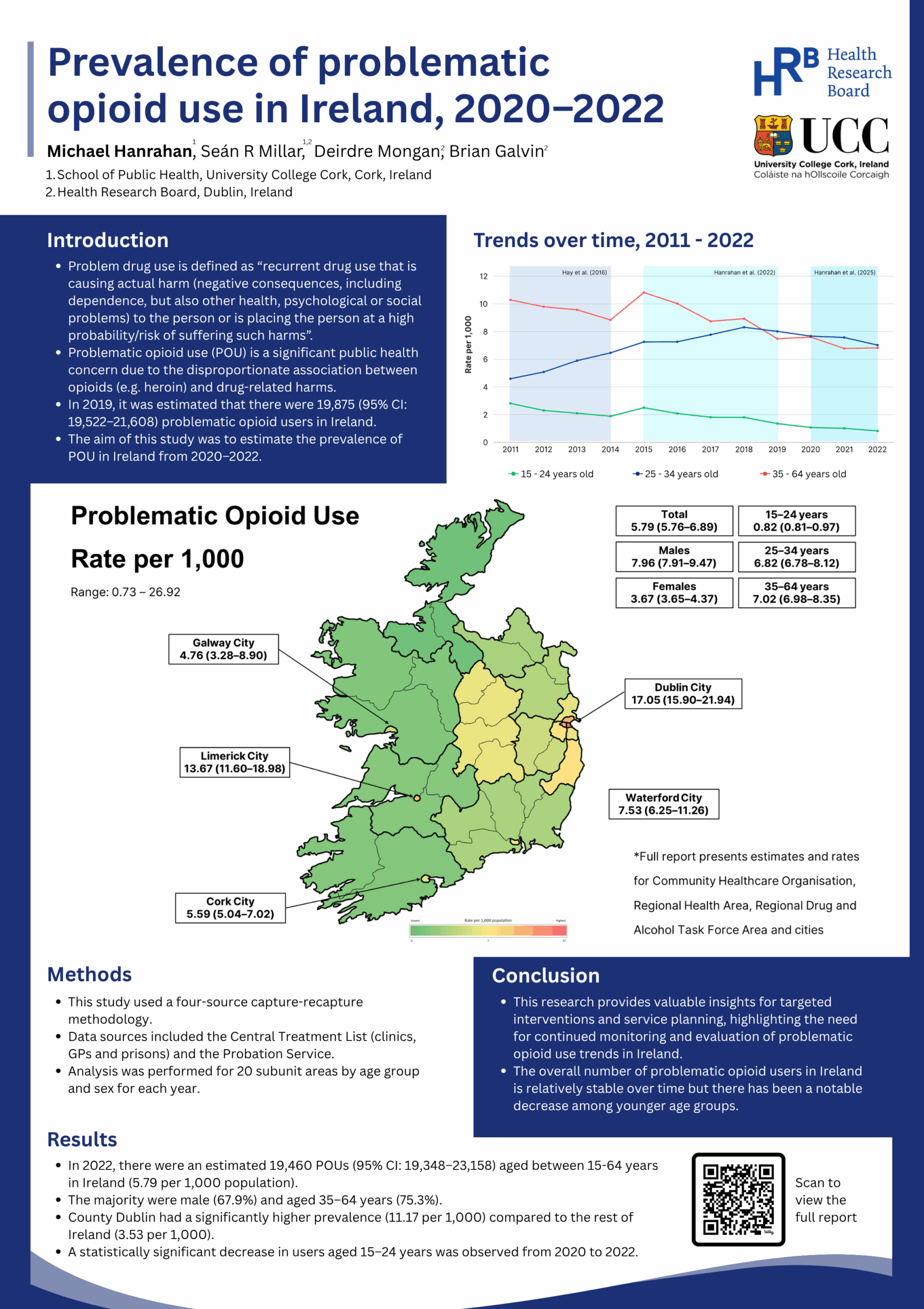
The most recent estimates indicate that Ireland had approximately 19,460 individuals with problematic opioid use in 2022, representing a prevalence rate of 5.79 per 1,000 population. This figure reflects relative stability compared to 20,985 in 2020 and 19,850 in 2021, suggesting the overall scale has plateaued rather than escalated. However, these numbers position Ireland among European countries with the highest rates of problematic opioid use.
The demographic profile shows distinct patterns: males constitute 68% of users, with the majority (75.3%) aged 35-64 years. Significantly, only 527 individuals aged 15-24 were estimated to have problematic opioid use in 2022, down from 685 in 2020. This decline in younger users represents one of the most encouraging trends in recent data, potentially indicating effective prevention efforts or changing drug preferences among youth.
Geographic Concentration and Regional Disparities
The distribution of problematic opioid use demonstrates stark regional inequalities. County Dublin accounts for 57% of all cases, with an estimated 11,100 individuals affected and a prevalence rate of 11.17 per 1,000 population—more than three times higher than the rest of Ireland (3.53 per 1,000). This concentration reflects historical patterns dating to Dublin’s heroin epidemic of the 1980s and 1990s.
Within Health Service Executive regions, Dublin and Midlands shows the highest prevalence at 8.49 per 1,000, whilst the West and North West region has the lowest at 1.60 per 1,000. These disparities have profound implications for service planning and resource allocation, with Dublin-based services bearing disproportionate caseloads.
Treatment System and Service Provision
Ireland’s treatment response centres on opioid substitution treatment (OST) delivered through specialist clinics, general practitioners, and community pharmacies. The Central Treatment List registered approximately 11,486 individuals for OST in 2021, with 95% receiving methadone maintenance treatment. Buprenorphine-based products, introduced nationally in 2017, account for the remaining 5%.
The treatment system operates through a four-tier model, from basic advice (Tier 1) to residential services (Tier 4). However, challenges persist including waiting lists, limited treatment options in some areas, and suboptimal GP participation rates—only 43.3% of eligible GPs participated in the National Drug Treatment Reporting System in 2023.
Recent data shows concerning trends in treatment demand. In 2023, cocaine became the most common drug for treatment admissions (37.6% of cases), whilst opioid cases decreased to 29.3%. This shift reflects changing drug use patterns, with crack cocaine use increasing by 594% between 2017 and 2023.
Drug-Related Mortality and Emerging Concerns
Drug-related deaths remain a persistent challenge. The National Drug-Related Deaths Index recorded 354 drug poisoning deaths in 2021, down from 439 in 2020. Opioids, primarily methadone, were implicated in 69% of deaths. Polysubstance use featured in 80% of deaths, highlighting the complexity of contemporary drug use patterns.
The emergence of crack cocaine as a significant public health issue represents a new challenge. Dublin drug counsellors report a crisis situation, with communities struggling to cope with the scale of use. This trend, attributed partly to heroin shortages following geopolitical changes in Afghanistan, requires adapted prevention and treatment approaches.
Policy Framework and Strategic Response
Ireland’s response is guided by “Reducing Harm, Supporting Recovery: A health-led response to drug and alcohol use in Ireland 2017-2025”. This strategy emphasises five goals: promoting health and wellbeing, minimising harms, addressing drug markets, supporting community participation, and developing evidence-informed policies.
Key developments include the introduction of supervised injecting facilities, expansion of OST options, and enhanced community-based services. The strategy commits to examining alternative approaches to personal drug possession, reflecting international interest in drug policy reform.
Emerging Challenges and Future Directions
Several trends present new challenges for Ireland’s response. The dramatic increase in crack cocaine use requires different prevention and treatment approaches compared to traditional opioid services. The potential emergence of synthetic opioids like fentanyl poses particular risks given their association with overdose deaths internationally.
The ageing opioid-using population will require adapted services addressing complex health needs and age-related comorbidities. Meanwhile, maintaining the positive trend of reduced initiation among young people requires sustained prevention efforts and vigilance regarding new substance trends.
Recommendations and Conclusions
The data suggests Ireland’s response to problematic opioid use shows mixed results. The stabilisation of overall prevalence and decline in younger users are encouraging, but the geographic concentration in disadvantaged areas and emergence of new drug trends require continued attention.
Priority actions should include: enhanced investment in prevention programmes targeting social determinants; improved treatment access and quality, particularly outside Dublin; expanded harm reduction services addressing cocaine use; and strengthened community-based support systems. The health-led approach provides a solid foundation, but implementation must be sustained and adapted to address evolving challenges.
Ireland’s experience demonstrates both the persistence of drug-related problems and the potential for effective intervention. With continued commitment from government, health services, and communities, further progress in reducing harms and supporting recovery remains achievable.
- https://www.hrb.ie/wp-content/uploads/2025/04/Prevalence-of-problematic-opioid-use-in-Ireland-2020-22.pdf
- https://www.drugsandalcohol.ie/40534/8/Treatment.pdf
- https://www.hrb.ie/wp-content/uploads/2024/07/NDTRS-Drug-treatment-demand-2023-bulletin.pdf
- https://www.euda.europa.eu/system/files/media/publications/documents/11346/ireland-cdr-2019.pdf
- https://www.bbc.com/news/articles/c0m0mjvlg1eo
- https://www.drugsandalcohol.ie/deaths-data/
- https://www.hrb.ie/press-releases/drug-and-alcohol-deaths/hrb-reports-latest-drug-poisoning-deaths-figures/
- https://gov.ie/en/department-of-health/press-releases/taoiseach-launches-reducing-harm-supporting-recovery-a-health-led-response-to-drug-and-alcohol-use-in-ireland-2017-2025/
- https://gov.ie/en/department-of-health/publications/reducing-harm-supporting-recovery-2017-2025/
- https://www.hrb.ie/press-releases/european-drug-report-2024/
- https://www.ucc.ie/en/media/academic/epidemiologyandpublichealth/2025/ProblemDrugUseinCorkCityReport.pdf
- https://www.drugs.ie/downloadDocs/2017/ReducingHarmSupportingRecovery2017_2025.pdf
- https://www.drugsandalcohol.ie/25261/
- https://www.drugsandalcohol.ie/6586/1/656-0614.pdf
- https://www.drugsandalcohol.ie/27603/
- https://www.euda.europa.eu/publications/european-drug-report/2024/drug-induced-deaths_en
- https://www.hrb.ie/wp-content/uploads/2024/06/Drug_treatment_in_Ireland_2015_to_2021.pdf
- https://www.drugsandalcohol.ie/25577/
- https://www.hse.ie/eng/about/who/primarycare/socialinclusion/about-social-inclusion/researchreports/research-for-social-inclusion-groups.html
- https://www.drugsandalcohol.ie/4272/1/791-0739.pdf
- https://www.citywide.ie/assets/files/pdf/cdatf_outcome_report_drug_harms.pdf
- https://www.euda.europa.eu/about/partners/reitox/ireland_en
- http://hrb.newsweaver.ie/drugnet/kzdb1g9tkz9